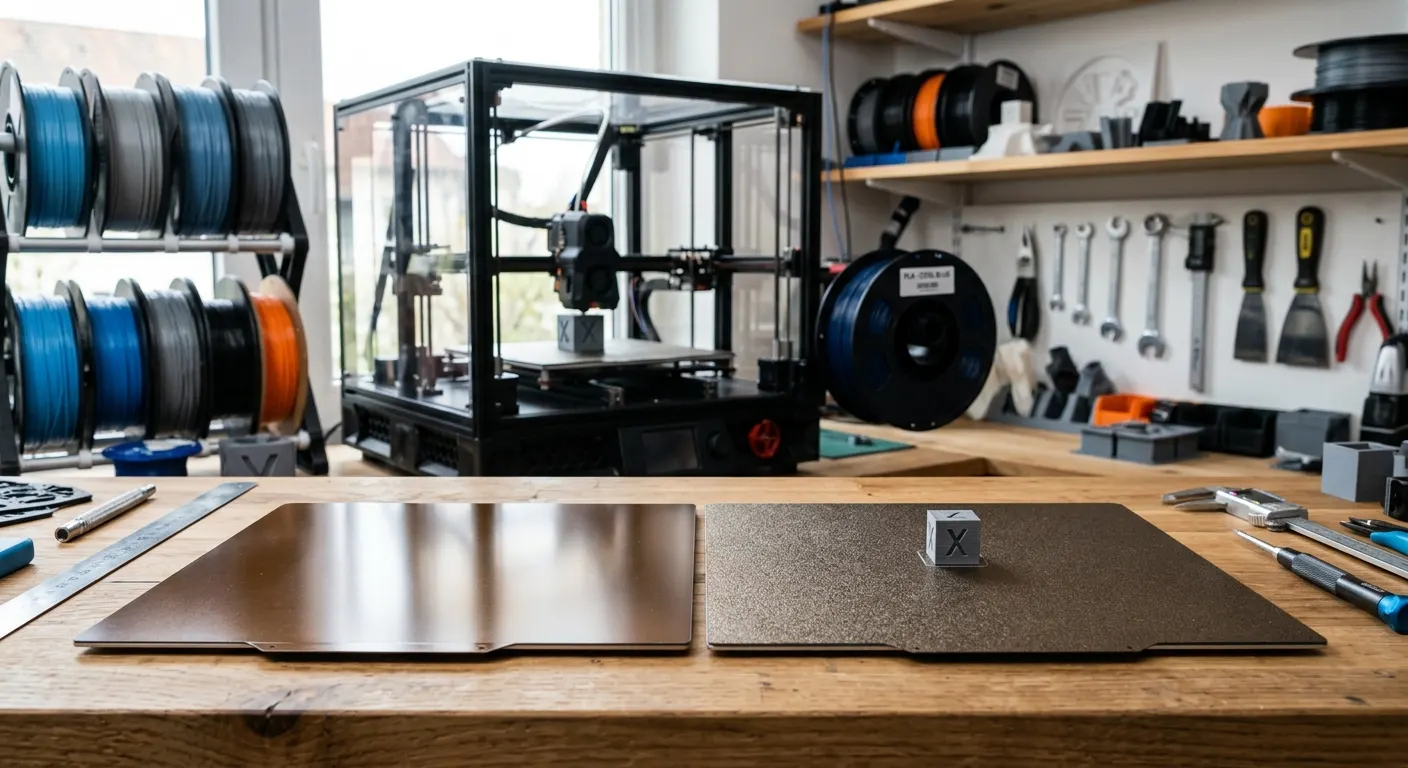
The choice between smooth and textured PEI build plates is one that most FDM users have to make at least once, and often make incorrectly the first time. Smooth PEI provides higher first-layer adhesion and a glossy bottom surface. Textured PEI provides a matte first layer that hides adhesion artifacts and handles PETG and TPU release more reliably. Both have real advantages depending on the material and the intended use of the print. This guide maps the material-to-surface relationship clearly so you can choose once and print confidently.
Quick answer
Textured PEI is the safer everyday build plate for mixed PLA, PETG, and TPU printing, since it releases parts cleanly and hides first-layer flaws. Smooth PEI gives the strongest grip and a glossy finish, best for PLA and warp-prone ABS or ASA parts. Neither surface grips nylon; use G10 Garolite instead.
This guide contains affiliate links. LayerGrade may earn a commission at no cost to you.
The core difference: adhesion strength and surface finish
Smooth PEI provides adhesion through direct chemical interaction between the PEI surface and the hot polymer. At elevated temperatures, polar polymers like PLA and PETG bond to the PEI surface strongly. The result is a high-adhesion surface that grips prints reliably and, on cooling, releases them with a flex of the spring steel substrate. The first layer of the print gets a smooth, slightly glossy finish from contact with the flat PEI surface.
Textured PEI adds a micro-texture to the surface, typically produced by sandblasting or an embossed pattern applied during manufacturing. This texture increases the contact surface area for adhesion while simultaneously reducing the adhesion force required for removal. The texture imprints onto the first layer, producing a matte finish that conceals any adhesion artifacts, Z-offset variation, or minor first-layer imperfections. For display prints where the bottom surface is visible, the matte texture often looks cleaner than a smooth bottom surface would.
The practical implication: smooth PEI is the correct choice when you need maximum adhesion for small or warp-prone parts and when bottom-surface appearance does not matter. Textured PEI is the correct choice when you want easier release, particularly for PETG and TPU, and when the matte first-layer finish suits the application.
PLA on smooth vs textured PEI
PLA adheres well to both smooth and textured PEI at 60 C bed temperature without any adhesion aid. The primary differentiator for PLA is aesthetic: smooth PEI produces a smooth, slightly reflective first layer, while textured PEI produces a matte, tactile first layer that conceals any minor adhesion imperfections.
For miniatures, display models, and prints where the base surface is visible or handled, the textured matte finish is often the preferred result. For technical prints where dimensional accuracy and a smooth bottom surface matter, smooth PEI is the correct choice since the texture imprints slightly onto the first layer can affect dimensional measurements of holes and fits.
Both the Bambu Lab Textured PEI Plate and the Energetic Smooth PEI Magnetic Sheet handle PLA at standard bed temperatures without glue or spray. The Wham Bam and Energetic sheets are available in smooth versions for Ender 3 users who want the smooth-surface option. For everyday PLA printing, either surface works: choose based on the finish you prefer on the first layer of your typical prints.
PETG: why textured is usually the safer choice
PETG is the material where build plate choice most directly determines whether your print session ends with a clean release or a damaged PEI coating. PETG bonds very aggressively to smooth PEI at typical PETG bed temperatures of 70 to 80 C. On removal, a PETG print on smooth PEI can tear chunks of the PEI coating off with it, permanently degrading the surface after just a few prints.
Textured PEI provides enough adhesion for reliable PETG first layers while the texture structure reduces the total adhesion force required for removal. The Bambu Lab Textured PEI Plate handles PETG on A1 and A1 Mini printers without any adhesion spray or release agent at standard Bambu PETG profile temperatures. The Wham Bam PEI Spring Steel Sheet in a textured version handles the same role on Ender 3 and Prusa machines.
If you have a smooth PEI sheet and want to print PETG on it, the solution is Magigoo 3D Printer Bed Adhesion Stick applied as a thin release layer. The Magigoo formula acts as a barrier between the PETG and the PEI, maintaining adequate first-layer grip during printing while allowing clean release when the bed cools. This is the workflow for users who only have smooth PEI and occasionally need to print PETG, rather than buying a second textured sheet.
Always allow the plate to cool fully to room temperature before attempting PETG removal. PETG releases best when completely cold. Attempting to flex the plate while still warm at 40 to 50 C increases the force required for release and the risk of coating damage.
TPU: direct-drive required, surface is secondary
TPU prints reliably on both smooth and textured PEI at a bed temperature of 45 to 55 C. The primary limiting factor for TPU is not the build surface but the extruder type: TPU on a long Bowden extruder setup, such as a stock Ender 3, buckles inside the PTFE tube during retractions and feeds inconsistently. The Creality Sprite Pro Extruder direct-drive conversion is required before reliable TPU printing on a Bowden Ender 3, regardless of build surface choice.
On direct-drive machines like the Bambu A1, A1 Mini, and Prusa MK4, Overture TPU 95A Flexible Filament at 95A Shore hardness prints reliably on the standard textured PEI surface without any adhesion aid. The textured plate provides adequate grip and releases TPU prints more easily than smooth PEI because the texture reduces total contact area with the flexible part.
TPU is moisture-sensitive. Store Overture TPU 95A Flexible Filament and other TPU spools in PrintDry Filament Container with Desiccant with Dry and Dry Rechargeable Silica Gel Desiccant after opening the factory vacuum seal. Wet TPU produces heavy stringing and rough surfaces that no build plate selection will fix, so address moisture storage before optimizing the surface.
ABS, ASA, and engineering materials: beyond standard PEI
ABS and ASA require an enclosure to prevent warping from differential cooling between layers. On an Ender 3, the Enclosure Hardware Kit for IKEA Lack Table kit provides a cost-effective path to an enclosed print environment. Bambu P1S and X1C include built-in enclosures and handle ABS and ASA reliably with appropriate temperature profiles.
Smooth PEI is generally preferred for ABS and ASA over textured PEI, since these materials need the higher adhesion force to resist warping during printing at the 100 to 110 C bed temperatures that 2026 build-plate comparisons compiled by 3DSearch recommend for ASA. A thin layer of Magigoo 3D Printer Bed Adhesion Stick on smooth PEI improves first-layer grip further and also provides a controlled release when the print cools, which reduces the risk of the part warping off the surface during printing.
For nylon and PA-CF, neither smooth nor textured PEI provides adequate adhesion. The G10 Garolite Build Plate is the required surface for these materials. Nylon bonds to Garolite at print temperature and releases cleanly when cooled, a mechanism that PEI chemistry does not replicate. Keep a G10 sheet as a dedicated nylon surface and swap back to PEI for everyday PLA and PETG.
Product recommendations by printer platform
For Bambu Lab A1, A1 Mini, P1P, P1S, and X1C users: the Bambu Lab Textured PEI Plate is the correct default surface for PLA, PETG, and TPU. It is the purpose-designed surface for these machines and is validated against Bambu slicer temperature profiles. Keep a spare for rotation if you print at high volume.
For Ender 3 and Prusa MK3S, MK4, and MINI users: the Wham Bam PEI Spring Steel Sheet is the highest-durability third-party option and is available in both smooth and textured versions in 235x235 mm and other standard sizes. Budget-conscious users should consider the Energetic Smooth PEI Magnetic Sheet , which provides adequate PLA and PETG adhesion at a lower price with the trade-off of shorter coating lifespan.
Cleaning is the maintenance habit that extends the life of any PEI surface. Use Amazon Basics Isopropyl Alcohol 99% at 99 percent concentration on a lint-free cloth before every print. Periodic deep cleaning with warm water and dish soap removes residue that IPA cannot clear after many print cycles. Handling the plate by the edges after cleaning preserves the clean surface until the print starts.
FAQ
Frequently asked questions
Which PEI surface is better for everyday mixed-material printing?+
Textured PEI is the better all-around choice for users who mix PLA, PETG, and TPU. It handles all three materials reliably without adhesion aids, releases prints more cleanly than smooth PEI for PETG and TPU, and hides first-layer imperfections with the matte finish. Smooth PEI is the better choice if you print primarily PLA and want a glossy bottom surface or need maximum adhesion for very small warp-prone parts.
Can I print PETG directly on smooth PEI?+
You can, but it risks damaging the PEI coating. PETG bonds very aggressively to smooth PEI at 70 to 80 C and can delaminate the coating on removal. If you use smooth PEI for PETG, apply a thin layer of a release agent like Magigoo before printing and always let the plate cool fully before attempting removal. Textured PEI is the simpler solution that avoids this trade-off.
What build plate should I use for nylon?+
Neither smooth nor textured PEI grips nylon well. G10 Garolite is the specialist surface for nylon, PA-CF, and similar materials. Nylon bonds to Garolite at print temperature and releases cleanly on cooling without hairspray or special treatment. Keep a G10 sheet sized to your bed as a dedicated nylon surface and return to PEI for PLA, PETG, and TPU.
Should I print ASA on smooth or textured PEI?+
Smooth PEI is generally the better surface for ASA, since the material needs strong first-layer grip at a 100 to 110 C bed temperature to resist warping, and 2026 build-plate comparisons compiled by 3DSearch rate smooth PEI's adhesion higher than textured for that job. Textured PEI still works for ASA if you add a thin layer of Magigoo 3D Printer Bed Adhesion Stick to make up the difference in hold.