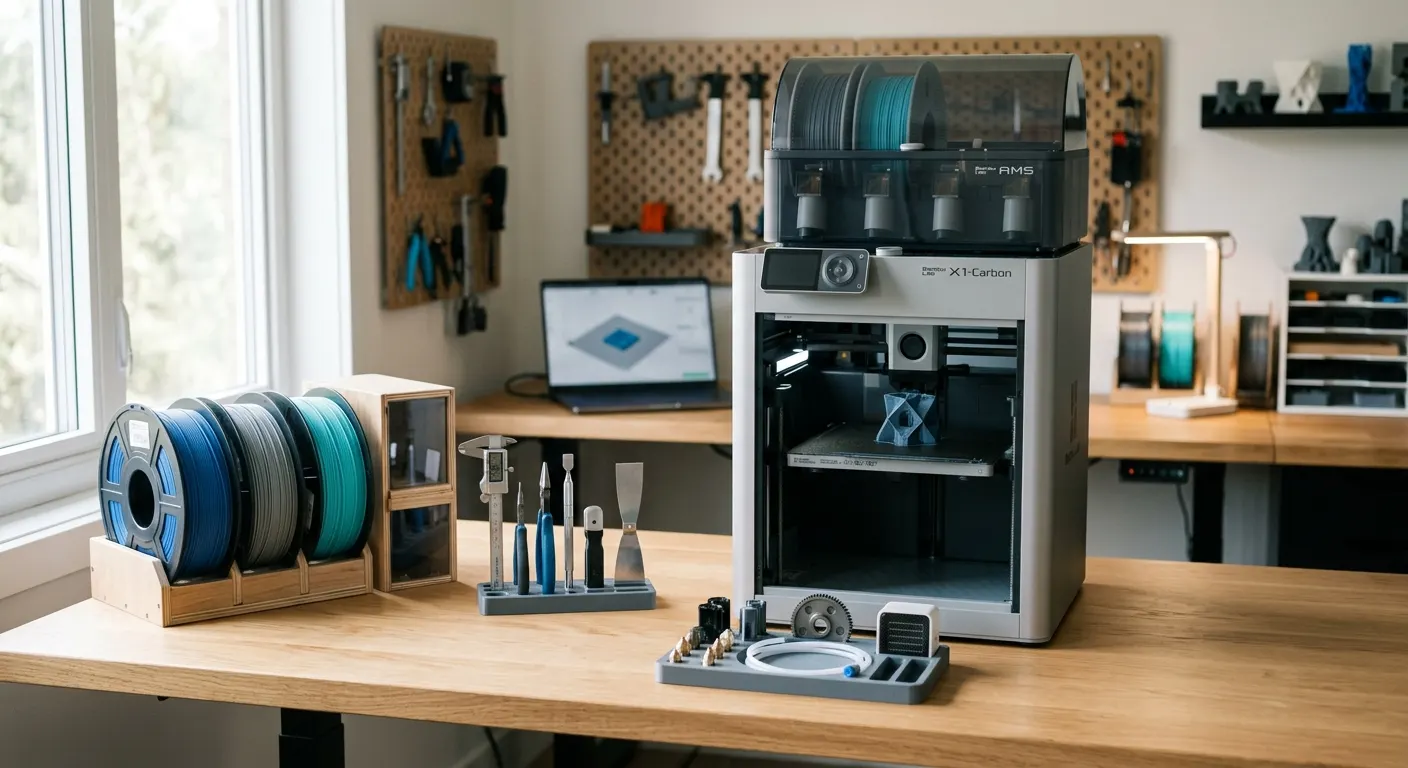
Bambu Lab printers ship in a remarkably complete state. The X1C and P1S handle automatic bed leveling, vibration compensation, and filament runout without any modification. The temptation to immediately buy every accessory advertised for Bambu machines is understandable but not always warranted. The upgrades that actually improve print quality or workflow are specific: the right build plate for your materials, a filament dryer for moisture-sensitive filaments, a hardened nozzle before the first carbon fiber spool, and the AMS Lite or AMS 2 Pro if multi-material printing is your goal. This guide separates the meaningful Bambu Lab accessories from the noise.
Quick answer
Buy four Bambu accessories that earn it: a textured PEI plate for everyday PLA and PETG, a filament dryer for moisture-sensitive PETG and TPU, a hardened steel nozzle before your first carbon fiber spool, and the AMS Lite only if you actually want multi-material printing. The stock machine already handles leveling and vibration.
This guide contains affiliate links. LayerGrade may earn a commission at no cost to you.
Build plates: the first upgrade most Bambu users need
Bambu Lab printers ship with a basic cool plate that works for PLA and some PETG, but the Bambu Lab Textured PEI Plate is the surface most users should have installed for everyday printing. The micro-textured PEI grips hot prints firmly and releases them at room temperature without tools or force. The matte first-layer finish it imprints is cleaner than what the smooth cool plate produces on most filament types.
The textured plate handles PLA, PETG, and TPU without adhesion spray or glue on a Bambu printer running the correct bed temperature profiles. If you print exclusively PLA and use the default Bambu slicer profiles, the textured plate is a straightforward improvement over the stock cool plate for every session. At $18 to $25, it is also the lowest-cost meaningful upgrade in the Bambu ecosystem.
For users printing nylon, PA-CF, or PC on a Bambu printer with an enclosure, the Engineering Plate is the correct surface choice. The textured PEI plate does not provide adequate first-layer adhesion for these materials. For the majority of Bambu users running PLA and PETG, however, the Bambu Lab Textured PEI Plate is the build plate recommendation.
Filament dryers: why Bambu AMS users need one
The Bambu AMS holds four spools at once and feeds them on demand, but it does not dry them. Spools sitting in the AMS while not printing are exposed to ambient humidity. PETG and TPU in a moderately humid room will absorb enough moisture to produce stringing and surface defects within a few days of unprotected storage. The SUNLU FilaDryer S4 is purpose-suited for multi-material AMS workflows because it holds four spools and can run print-in-dryer mode, feeding the AMS while actively maintaining low-humidity conditions.
For Bambu users who print primarily PLA and want the simplest solution, the SUNLU FilaDryer S2 handles one spool at a time and costs under $50. If your print queue is primarily single-material and you notice stringing that retraction tuning has not eliminated, drying the active spool for three to four hours at 50 degrees Celsius is the fastest diagnostic step.
The EIBOS Filament Dryer Box is the step up from the SUNLU S2 if you want data confirmation of drying completion. The live humidity display tells you when the spool has actually reached a low-humidity target rather than requiring you to estimate based on elapsed time at temperature. For PETG and TPU specifically, where partial drying still produces print defects, the EIBOS humidity readout is genuinely useful.
Nozzles: hardened steel before any carbon fiber spool
The stock Bambu brass nozzle degrades visibly within a single spool of Bambu CF-PA or CF-PET filament. The abrasive carbon fiber particles in composite filaments strip brass material from the nozzle bore, enlarging it and producing over-extrusion artifacts that worsen with each gram of abrasive filament printed. The Bambu Lab Hardened Steel Nozzle Kit is the required purchase before opening any Bambu composite or carbon fiber filament spool.
For standard PLA, PETG, and non-abrasive materials, the stock brass nozzle is appropriate and performs well. The hardened steel nozzle requires a 5 to 10 degree Celsius higher print temperature than brass due to lower thermal conductivity, Bambu slicer profiles account for this automatically when the correct nozzle type is selected in the settings.
Users who want to expand material capability further should consider the BIGTREETECH Panda Revo Hotend for ABS, ASA, PA, and PC printing above 260 degrees Celsius. The stock Bambu hotend contains a PTFE liner in the melt zone that limits reliable continuous printing above approximately 240 to 250 degrees. The Panda Revo replaces this with an all-metal heat block that removes the temperature ceiling.
The AMS Lite upgrade: when multi-material printing is worth it
The Bambu Lab AMS Lite is the multi-material upgrade for A1 and A1 Mini users. It holds four spools, switches between them automatically during a print job, and integrates with Bambu slicer's painted model multi-color workflow. For A1 series users who want to print multi-color models, the AMS Lite converts the printer into a tool that handles the spool-switching logistics automatically.
Multi-material printing with the AMS Lite generates a purge tower, a wasted extrusion block that clears the previous material from the nozzle before printing the next. The purge tower volume can be significant for prints with frequent color transitions. Bambu slicer provides purge-volume controls that let you reduce waste at the cost of potential color bleed between adjacent areas. Finding the right balance requires a few test prints.
If your printing goal is primarily functional single-material parts, the AMS Lite is not a priority purchase. The benefit is specific to multi-color aesthetic printing. If multi-color miniatures, figures, or logos are in your planned print queue, the AMS Lite is the feature that makes it practical rather than requiring manual filament changes between colors.
Filament recommendations for Bambu printers
Bambu Lab printers are validated against Bambu-branded filament and the Bambu slicer profiles reflect this. Third-party filament works well on Bambu machines, but it requires either using the generic slicer profiles or creating custom profiles based on the filament specs. Polymaker PolyTerra PLA is the most reliable third-party PLA for Bambu printers, Polymaker's diameter tolerance and consistency align well with Bambu's precise filament path, and the matte finish is popular for display prints.
For PETG, Polymaker PolyLite PETG performs consistently on Bambu hardware with the generic PETG profile. PETG on Bambu machines is more prone to stringing than PLA, particularly with the textured plate, because PETG adheres aggressively. A thin layer of glue stick on the textured plate acts as a release agent that makes print removal easier without affecting first-layer adhesion.
If moisture-related print quality is a concern, and it will be if your printer runs in a humid environment, the SUNLU FilaDryer S4 in print-in-dryer mode is the most effective solution for maintaining consistent results across all four AMS slots simultaneously.
FAQ
Frequently asked questions
Do I need to buy Bambu Lab branded accessories, or will third party parts work?+
You are not locked in for everything. Filament, generic tools, and spring steel plates of the right size work fine. But proprietary parts like the Bambu nozzle and AMS are designed for the ecosystem and slicer profiles, so they are the safe choice for those. Match third party plates to your exact bed size and use generic slicer profiles for non Bambu filament.
Which build plate should I use on my Bambu Lab printer?+
For everyday PLA, PETG, and TPU, the textured PEI plate is the best default. It grips hot prints, releases them cold, and leaves a clean matte first layer without glue. The stock cool plate works for PLA but is less forgiving. For nylon, PA-CF, or PC in an enclosed machine, switch to the engineering plate, which PEI cannot replace for those materials.
Do AMS users need a filament dryer?+
Often yes. The AMS holds and feeds four spools but does not dry them, so spools sitting inside still absorb ambient humidity. PETG and TPU can string within days in a humid room. A four spool dryer running in print in dryer mode conditions the whole AMS set at once and keeps results consistent across all four channels during long prints.