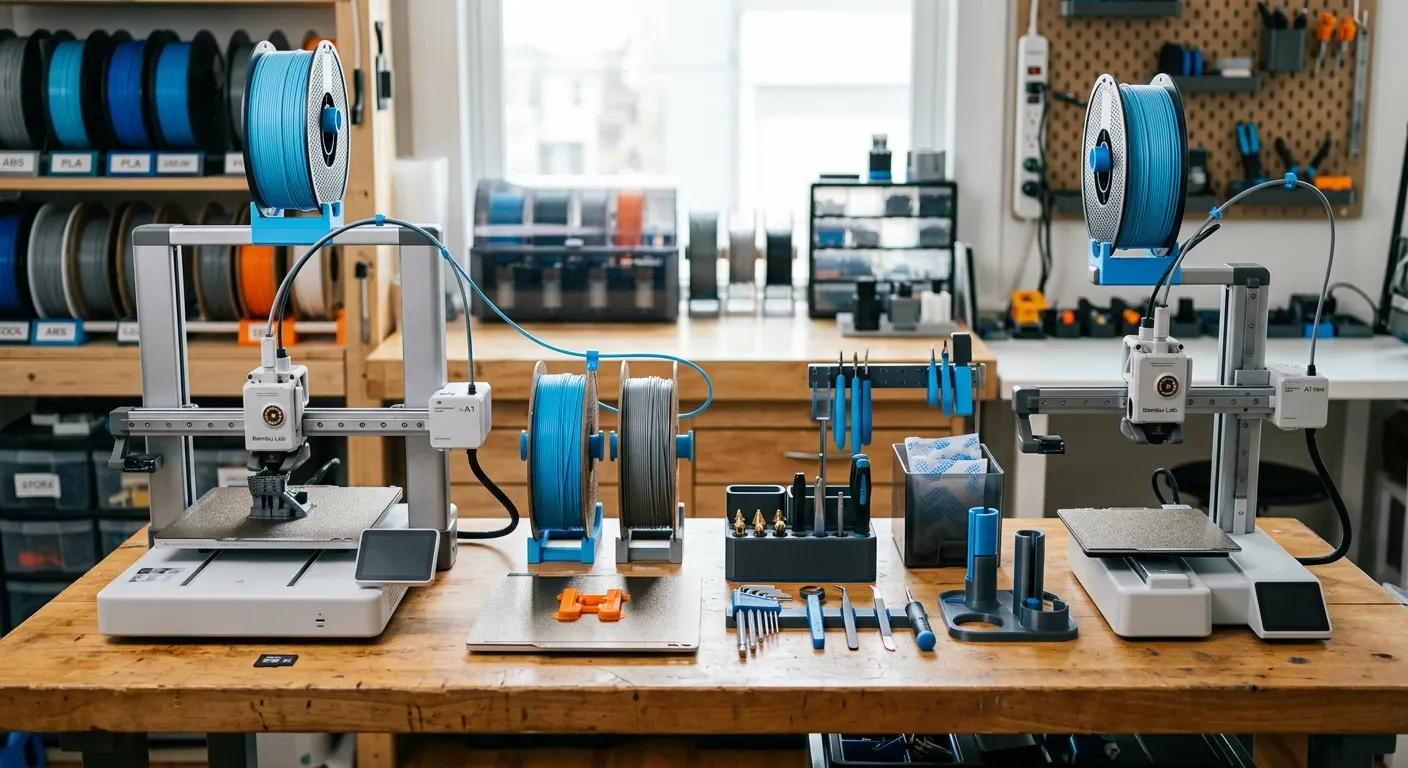
The Bambu Lab A1 and A1 Mini ship with auto bed leveling, vibration compensation, and a well-tuned print profile that handles PLA and PETG reliably on day one. The instinct to immediately buy every accessory marketed for these machines is understandable but not always warranted. The accessories that produce real improvements are specific: the correct build plate for your material rotation, a filament dryer if moisture is your limiting variable, hardened nozzles before the first carbon fiber spool, and the AMS Lite if multi-material printing is your actual goal. This guide covers each category with honest notes on what to buy, what to skip, and why.
Quick answer
The A1 and A1 Mini ship with a textured PEI plate that already handles PLA and PETG, so skip plate upgrades unless you want a spare or a G10 sheet for nylon. The accessories that matter are a filament dryer for PETG and TPU, a hardened nozzle before carbon fiber, and the AMS Lite once multi-color printing is your goal.
This guide contains affiliate links. LayerGrade may earn a commission at no cost to you.
Build plates: the first accessory most A1 owners should buy
The A1 and A1 Mini ship with a textured PEI plate as the default surface. For most users printing PLA and PETG, this plate is the correct surface and does not need to be replaced immediately. The micro-textured PEI grips hot prints firmly, releases them cold, and leaves a clean matte first layer without any spray or glue for PLA, PETG, and TPU on standard Bambu slicer profiles.
Where buying a second Bambu Lab Textured PEI Plate makes sense is when you want a dedicated spare for rotation. Having two plates means you can start a new print on the warm plate while the previous one cools on the spare, which improves throughput on busy print days. The plate is relatively inexpensive and the convenience is real for high-volume users.
If you print primarily PLA and care about a smooth, glossy bottom surface on your prints, a smooth PEI option provides stronger first-layer grip and a different aesthetic. The textured plate is the better all-around choice for mixed-material printing, but the surface finish preference is worth considering based on your typical print goals.
For nylon, PA-CF, or other engineering materials on a fully enclosed A1 print setup, neither PEI variant provides adequate adhesion. The G10 Garolite Build Plate is the specialist surface for these materials. Keep it as a dedicated nylon surface alongside your standard textured plate and swap when changing material type.
Filament dryers: essential for PETG and TPU users
The A1 and A1 Mini do not dry their filament. Spools sitting in the open or in an AMS Lite that has been idle for days are absorbing ambient humidity. PETG and TPU in a room above 50 percent relative humidity can absorb enough moisture within 24 to 48 hours to produce visible stringing and rough surface texture.
The SUNLU FilaDryer S2 is the right first filament dryer for A1 and A1 Mini users who print one material type at a time. At under $50, it functions both as a dryer and as a diagnostic tool. If stringing that you have been attributing to slicer settings disappears after a four-hour drying cycle, moisture was the variable.
For A1 users who run an AMS Lite with multiple filaments loaded, the SUNLU FilaDryer S4 four-spool design matches the AMS Lite capacity. All four spools can be conditioned in a single cycle, and the dual feed ports allow two spools to print in print-in-dryer mode while the other two are drying. The digital temperature control on the S4 is also more precise than the dial on the S2, which matters when targeting specific temperatures for different materials in the same cycle.
The EIBOS Filament Dryer Box is the single-spool alternative for users who want the live humidity display that confirms drying completion. If you are printing engineering materials like nylon or CF composites where incomplete drying produces immediate and obvious print failures, the EIBOS humidity readout eliminates the guesswork about whether another drying cycle is warranted.
Nozzles: required before any carbon fiber or composite spool
The A1 and A1 Mini ship with a brass nozzle. Brass is the correct choice for standard PLA, PETG, and non-abrasive materials, its high thermal conductivity produces consistent melt flow. But brass degrades visibly within a single spool of any abrasive composite filament: the carbon fiber, glass fiber, or metal-fill particles grind the brass bore larger with every gram printed, causing over-extrusion that worsens progressively.
Before opening any spool of CF-PA, CF-PET, CF-PLA, or other composite filament, install the Bambu Lab Hardened Steel Nozzle Kit . This is the official Bambu hardened steel nozzle for the A1 series. Hardened steel nozzles require a 5 to 10 C higher print temperature than brass due to lower thermal conductivity, and Bambu slicer accounts for this automatically when you select hardened steel nozzle in the filament profile settings.
For users pushing into high-temperature materials like ABS, ASA, PA, and PC above 260 C on a Bambu machine, the BIGTREETECH Panda Revo Hotend is the all-metal hotend upgrade. The stock Bambu hotend contains a PTFE liner in the melt zone that limits reliable continuous printing above approximately 240 to 250 C. The Panda Revo eliminates this limitation as a drop-in replacement for the A1 and A1 Mini. This is not a required upgrade for standard PLA and PETG printing, but it is the correct tool for users regularly printing high-temperature engineering materials.
AMS Lite: the multi-color upgrade when you are ready for it
The Bambu Lab AMS Lite is designed specifically for the A1 and A1 Mini. It holds four spools, handles automatic filament switching during print jobs, and integrates with Bambu slicer's painted model multi-color workflow. For A1 users who want to print multi-color models, the AMS Lite converts the printer into a tool that handles spool-switching logistics automatically.
Multi-material printing with the AMS Lite produces a purge tower alongside the actual print. The tower is wasted extrusion that clears the previous color from the nozzle before switching to the next. Purge volume settings in Bambu slicer let you reduce waste, but some purging is unavoidable with single-nozzle multi-material printing. This is worth understanding before buying: the AMS Lite creates a real trade-off between color capability and material waste per print.
The recommendation: hold off on the AMS Lite for the first 30 days. Learn the printer, understand how it behaves with your primary materials, and develop consistent single-color results before adding multi-material complexity. The AMS Lite is most valuable when you know what you want to print with it, not as a speculative day-one purchase.
Filament recommendations for A1 and A1 Mini
The A1 and A1 Mini are validated against Bambu-branded filament, and the default slicer profiles reflect this. Third-party filament works well on both machines but requires selecting a generic slicer profile or building a custom one from the filament manufacturer's specifications.
For third-party PLA, Polymaker PolyTerra PLA is one of the most reliable choices on Bambu hardware. Polymaker's diameter tolerance is among the tightest in consumer filament, and the matte surface finish is popular for display prints where concealing layer lines matters. For display-quality PLA with a matte finish, the PolyTerra is a better choice than commodity options.
For PETG on the A1 series, Polymaker PolyLite PETG performs consistently with the generic PETG slicer profile. PETG can over-adhere to the textured PEI plate if the bed temperature is set too high. Use Magigoo 3D Printer Bed Adhesion Stick as a thin release layer on the textured plate if you find prints bonding too firmly. For flexible prints, Overture TPU 95A Flexible Filament prints reliably on the A1 and A1 Mini at standard TPU settings without requiring any hardware modification, since both machines ship with direct-drive extruders.
FAQ
Frequently asked questions
Do I need to buy Bambu-branded accessories for the A1 and A1 Mini, or will third-party parts work?+
Filament and generic tools are fully compatible. For nozzles, the A1 series uses the standard Bambu nozzle format, and the official hardened nozzle kit is the safest choice for full slicer profile compatibility. Build plates of the matching size can be third-party if you verify the exact dimensions. The AMS Lite is a proprietary unit designed specifically for the A1 series and is not interchangeable with the AMS used on X1C and P1S printers.
Should I get the AMS Lite right away with my A1?+
Not necessarily as a day-one purchase. The AMS Lite is the right upgrade when multi-color printing is your actual goal, but it adds a learning curve around purge tower management and multi-material slicer settings. Learn the printer on single-material jobs first, get consistent results, then add the AMS Lite when you know what you want to print with it.
Do A1 users need a filament dryer?+
It depends on your climate and materials. For PLA in a dry environment, sealed storage with desiccant is often sufficient. For PETG and TPU in any climate above 50 percent relative humidity, a dryer is worth having. If you run an AMS Lite with multiple spools loaded, a four-spool dryer like the SUNLU S4 is the practical solution for conditioning the full AMS set simultaneously.