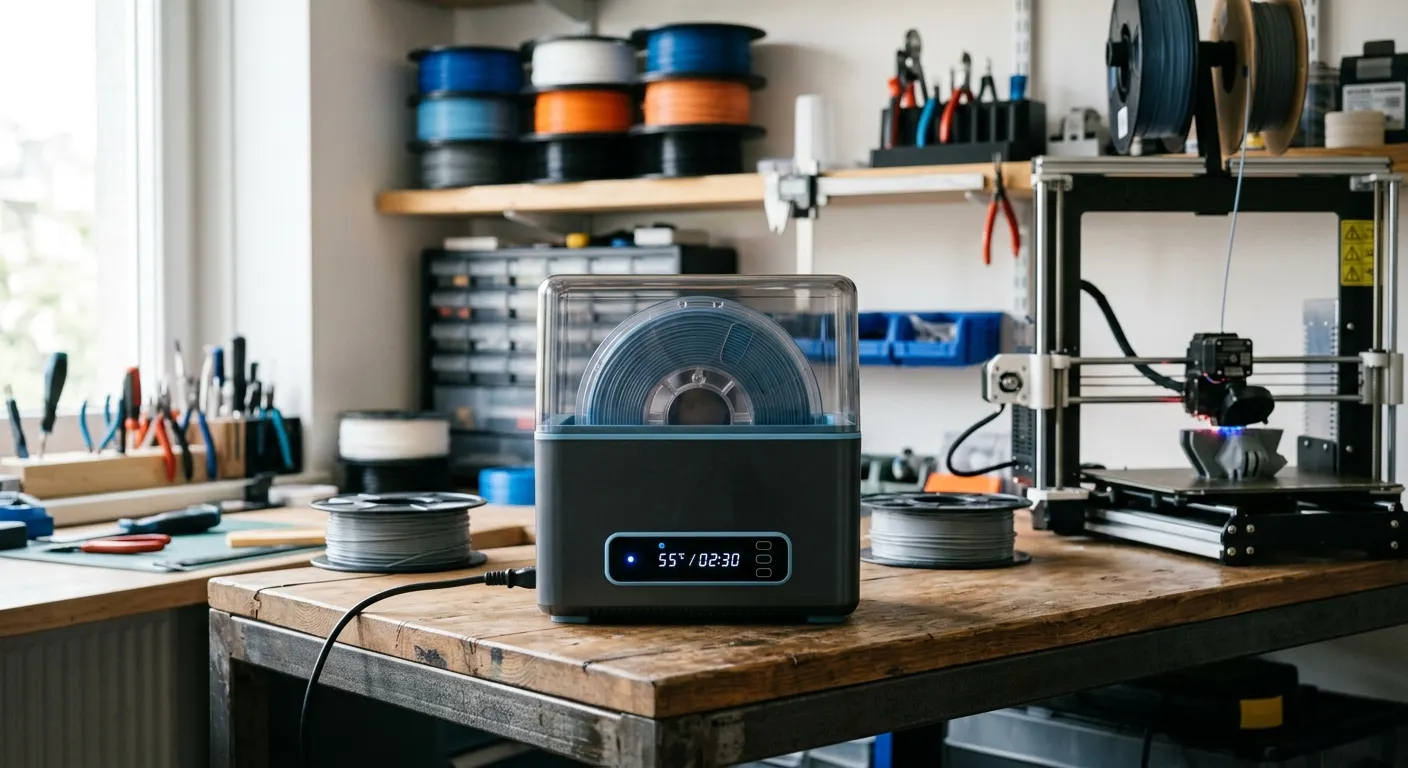
Filament moisture is the most underdiagnosed cause of print-quality problems, and the fix does not require an expensive dryer. Under $50 is enough to buy an active dryer that handles PLA through ABS, or to assemble a passive dry-storage system that keeps already-dried spools print-ready. The question for a budget buyer is which approach solves the actual problem: an active dryer removes moisture from a wet spool, while passive storage only prevents a dry spool from re-absorbing it. This guide covers the one active dryer that fits the budget, the passive gear that complements it, and how to confirm moisture was your problem before spending more.
Quick answer
Under $50, the SUNLU FilaDryer S2 is the pick. It covers PLA through ABS, runs during printing to keep filament dry, and works as a cheap diagnostic to confirm moisture is your problem. Pair it with PrintDry containers and rechargeable desiccant for passive storage, and a humidity monitor to verify your storage actually stays dry.
This guide contains affiliate links. LayerGrade may earn a commission at no cost to you.
The active dryer that fits the budget: SUNLU FilaDryer S2
The SUNLU FilaDryer S2 is the active filament dryer that fits under the $50 ceiling, typically priced from the high $30s to low $50s, and it is the most widely recommended entry-level dryer in the hobby. Single-spool capacity is not a limitation for most budget buyers who print one material type at a time, and its heating range covers the materials a new printer actually uses.
The S2 heats from 35 to 70 degrees Celsius, which covers PLA at 45 to 55 degrees, PETG and TPU at 60 to 65 degrees, and ABS and ASA at 65 to 70 degrees. The temperature dial is less precise than the digital controls on more expensive units, but accuracy at set point is adequate for those material targets. For a budget buyer, that range covers everything short of nylon, which needs higher temperatures than any sub-$50 dryer reaches.
Print-in-dryer operation is the feature that makes the S2 worth more than its price suggests. Thread the filament out through the guide port directly into the extruder and run the dryer continuously during printing. In a humid room, filament re-absorbs moisture within hours of leaving a dryer, so keeping the active spool heated through a long print is the difference between a clean result and stringing that returns mid-job.
Use the S2 as a cheap diagnostic first
The strongest argument for a budget dryer is that it costs little to find out whether moisture is your problem at all. Stringing, rough surface texture, and weak layers look identical whether the cause is wet filament or slicer settings, which sends new users down a tuning rabbit hole when the actual variable is the spool's moisture content.
Run the test before you spend hours in the slicer. Load the suspect spool into the SUNLU FilaDryer S2 , set 60 to 65 degrees for PETG or 45 to 55 degrees for PLA, run it for four to six hours, then print a stringing test. If the stringing drops dramatically, moisture was the variable and the dryer has paid for itself in a single session. If it does not change, the problem is elsewhere and you have ruled out a major suspect cheaply.
This diagnostic value is why a budget single-spool dryer is the right first purchase even for users who may eventually want a larger unit. Confirm that drying matters for your climate and materials before scaling up to a four-spool dryer that costs more than the budget here allows.
Passive dry storage: stretching the budget further
Active drying restores wet filament; passive storage keeps a dried spool dry between sessions, and it is far cheaper. For a budget buyer, the combination is more cost-effective than buying a second active dryer. PrintDry Filament Container with Desiccant containers seal a spool behind a silicone gasket and hold a desiccant packet, providing multi-month moisture protection for well under the price of the dryer itself.
Dry and Dry Rechargeable Silica Gel Desiccant are the right desiccant for this. The color-indicating beads change from orange to clear when saturated, so you know when to recharge them by heating in an oven, and the reusable design eliminates the recurring cost of single-use silica packets across a growing collection. The workflow is simple: dry the spool in the S2, then seal it in a PrintDry container with fresh desiccant while it is still warm.
In a dry climate below roughly 40 percent relative humidity, passive storage with rechargeable desiccant is often enough to keep PLA and PETG print-ready without active drying between sessions. The S2 then becomes a tool you reach for only when a spool has actually absorbed moisture, rather than a daily-use device.
Verify your storage actually stays dry
Passive storage only works if it actually maintains low humidity, and assuming the desiccant is keeping pace is how spools slowly re-absorb moisture inside a container that looks sealed. A Govee Temperature and Humidity Monitor placed inside the storage area turns that assumption into a measurement.
The Govee sensor logs humidity over Bluetooth and alerts when it crosses a threshold you set, prompting a desiccant recharge before the filament is affected. Knowing the actual relative humidity near your storage tells you whether the desiccant is doing its job and whether your climate even requires active drying, which informs whether the budget S2 is enough or whether you will eventually need more capacity.
All three of these companions, the storage containers, the rechargeable desiccant, and the humidity monitor, sit well under $50 individually, so a budget buyer can assemble the full S2-plus-storage system over a couple of purchases without exceeding what a single mid-range dryer would cost.
FAQ
Frequently asked questions
What is the best filament dryer under $50?+
The SUNLU FilaDryer S2 is the standard pick at this price. It holds one spool, heats from 35 to 70 degrees Celsius to cover PLA through ABS, and can run during printing so filament stays dry through long jobs. Single spool capacity is fine for most budget users who print one material at a time, and it doubles as a cheap way to test whether moisture is your problem.
Is a cheap filament dryer actually worth it?+
Yes, because it is the cheapest way to rule out the most underdiagnosed cause of bad prints. Stringing and rough surfaces often trace to wet filament, not slicer settings. A budget single spool dryer lets you dry a suspect spool, reprint a test, and confirm the cause in one session. If drying fixes it, the dryer has already paid for itself.
Can I just use storage containers and skip the dryer to save money?+
Only if your filament is already dry. Sealed containers with rechargeable desiccant prevent a dry spool from absorbing moisture, but they cannot remove moisture a spool has already taken on. In a dry climate, passive storage may be enough for PLA and PETG. In humid conditions, or for a spool that is already wet, you need an active dryer to restore it.