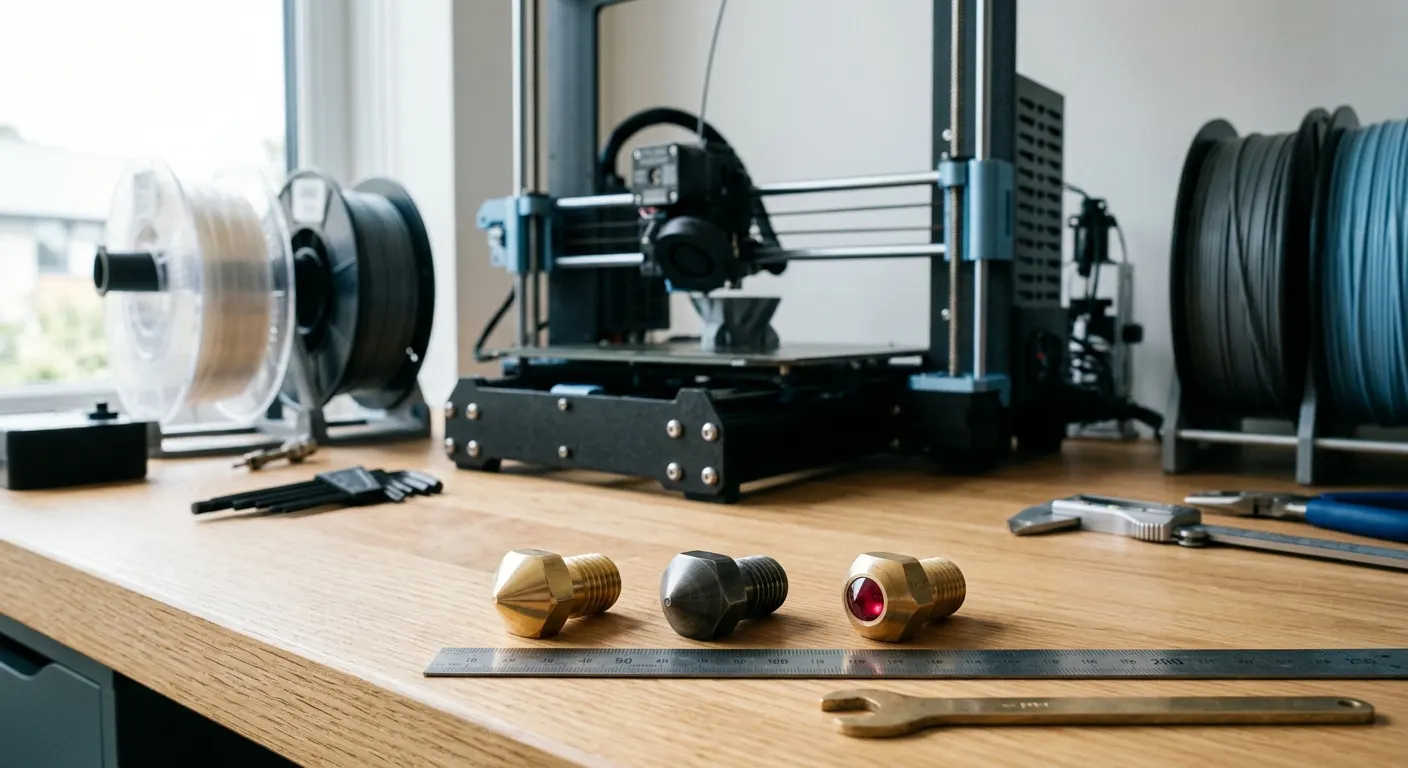
The nozzle is the cheapest part on an FDM printer and one of the most consequential. Its material sets two competing properties: how efficiently it conducts heat into the filament, and how well it resists the abrasive particles in composite filaments. Brass conducts heat best but wears fast on abrasives. Hardened steel resists abrasion at the cost of slightly lower thermal conductivity. Ruby-tipped nozzles combine a conductive body with a near-indestructible jewel orifice for the most demanding abrasive work. The right choice is not the most expensive option, it is the one that matches the filaments in your rotation. This guide makes that call material by material.
Quick answer
Use brass for standard PLA, PETG, and other non-abrasive filaments, where its high heat conductivity gives the cleanest flow. Switch to hardened steel before any abrasive filament, including carbon fiber, glass fiber, glow-in-the-dark, and metal fill, raising temperature about 5 to 10 degrees Celsius. Choose a ruby nozzle only for heavy, continuous abrasive printing.
This guide contains affiliate links. LayerGrade may earn a commission at no cost to you.
Brass: the best heat conductor for standard filament
Brass is the default nozzle material because it conducts heat into the filament more efficiently than any common alternative. That high thermal conductivity produces consistent melt behavior and clean flow at standard temperatures, which is exactly what you want for PLA, PETG, TPU, and other non-abrasive materials. For these filaments, brass is not a compromise, it is the correct choice, and moving to a harder material gains you nothing.
The weakness of brass is wear. It is a soft metal, and the abrasive fill in composite filaments strips material from the bore and enlarges the orifice. That widening shows up as over-extrusion and dimensional drift that worsens with every gram of abrasive filament. On standard filament, though, a brass nozzle holds its dimensions for a long service life.
Because brass is cheap, the right maintenance strategy is to keep spares and replace rather than fight a worn or clogged nozzle. A Creality MK8 Brass Nozzle Pack stocks twenty MK8-threaded nozzles for Creality hotends, enough that a clog or worn tip never costs more than a few minutes. For standard-filament printers, that pack is the entire nozzle plan.
Hardened steel: the abrasion-resistant standard
Hardened steel is the answer the moment abrasive filament enters your rotation. Carbon fiber, glass fiber, glow-in-the-dark, and metal-fill filaments contain particles that visibly enlarge a brass bore within a few hundred grams. Hardened steel resists that wear and holds its orifice dimensions across many spools of abrasive material, so a single hardened nozzle outlasts a stack of brass ones on the same filament.
The trade-off is thermal conductivity. Hardened steel conducts heat less efficiently than brass, so raise the print temperature roughly 5 to 10 degrees Celsius to keep flow consistent. That is the only meaningful setting change; otherwise it behaves like any nozzle of the same diameter, and some slicer profiles already account for nozzle material when you select it. The BIGTREETECH Hardened Steel Nozzle is the practical open-market option, available in multiple diameters with threading for E3D V6, Bambu, and Creality hotends.
On Bambu hardware, the Bambu Lab Hardened Steel Nozzle Kit is the official path. It guarantees slicer-profile compatibility and correct heat-block fit on the X1C, P1S, and P1P, and is the required purchase before opening any Bambu carbon fiber or composite spool, since the stock brass nozzle wears visibly within a single CF spool. For the great majority of users who print some abrasive filament but not continuously, hardened steel is the endpoint, not a stepping stone to ruby.
Ruby and hardened alternatives: the specialist tier
A ruby-tipped nozzle sets a synthetic ruby orifice into a conductive body, typically brass. The design aims to recover the heat conductivity that pure hardened steel sacrifices while making the orifice itself effectively impervious to abrasion. The ruby jewel does not wear measurably even under continuous carbon fiber or glass fiber printing, which is the property that justifies its place at the top of the range.
The catch is cost and scope. Ruby nozzles cost many times what a hardened steel nozzle costs, and that premium only pays off for users running abrasive filament heavily and continuously, where the labor of repeated hardened-steel swaps and the downtime between them start to matter. For occasional or even regular abrasive printing, hardened steel delivers the wear resistance you need without the specialist price.
There is no ruby nozzle in this catalog, and for most readers that is the correct reflection of the decision: the volume of abrasive printing that justifies ruby is uncommon. If your abrasive printing is heavy enough to wear through hardened steel, ruby is the next step. Until then, a BIGTREETECH Hardened Steel Nozzle or the Bambu Lab Hardened Steel Nozzle Kit on Bambu hardware covers the abrasion-resistance requirement at a fraction of the cost.
How to choose: match the nozzle to your filament
Start from the filaments you actually print. If your rotation is PLA, PETG, and TPU, stay on brass and keep spares; the heat conductivity gives the cleanest flow and the wear concern does not apply. A Creality MK8 Brass Nozzle Pack is the whole plan for a standard-filament Creality printer, and most non-abrasive filaments, from Hatchbox PLA 1.75mm Filament to Polymaker PolyLite PETG , run best on brass.
The moment you plan to open a carbon fiber, glass fiber, glow-in-the-dark, or metal-fill spool, switch to hardened steel first. Do not run abrasive filament through brass even once if you can avoid it, the wear begins immediately and is not reversible. Install the BIGTREETECH Hardened Steel Nozzle on open-market hotends or the Bambu Lab Hardened Steel Nozzle Kit on Bambu machines, and raise your temperature 5 to 10 degrees Celsius to compensate for steel's lower conductivity.
Reserve ruby for the narrow case of heavy, continuous abrasive production where hardened steel wear and swap downtime become real costs. For nearly everyone else, the two-nozzle answer is complete: brass for standard filament, hardened steel before anything abrasive. Buying ahead of the need, a hardened nozzle on the shelf before the first CF spool, is cheaper than the over-extrusion artifacts a worn brass nozzle leaves behind.
FAQ
Frequently asked questions
Is a hardened steel nozzle worth it if I only print PLA?+
No. PLA is not abrasive, so it does not wear a brass nozzle, and brass conducts heat better, which gives cleaner flow at standard temperatures. A hardened steel nozzle would only force a small temperature increase for no benefit. Stay on brass for PLA, PETG, and TPU, and keep a few spares for clogs and routine wear. Switch only when abrasive filament enters your rotation.
Do I need to change settings after installing a hardened steel nozzle?+
A little. Hardened steel conducts heat less efficiently than brass, so raise the print temperature roughly 5 to 10 degrees Celsius to keep flow consistent. Otherwise treat it like any nozzle of the same diameter. Some slicer profiles already adjust for nozzle material when you select it, so check your profile before manually changing the temperature.
When is a ruby nozzle actually worth the price?+
Only for heavy, continuous abrasive printing, where carbon fiber or glass fiber runs constantly enough that even hardened steel wears and the downtime of repeated swaps adds up. A ruby orifice does not wear measurably, but it costs many times more than hardened steel. For occasional or regular abrasive work, hardened steel delivers the abrasion resistance you need at a fraction of the cost.