Best Cleaning Tools for 3D Printing: FDM and Resin
By LayerGrade10 min readUpdated July 2026
AI-generated image
Most failed prints trace back to something dirty. On the FDM side it is a build plate carrying an invisible film of finger oils, or a nozzle dragging half-burnt plastic through every perimeter. On the resin side the stakes are higher: skipping a proper wash and cure workflow leaves parts tacky, brittle, and genuinely unsafe to handle bare-handed. The good news is that cleaning is the cheapest problem in 3D printing to solve properly. This guide covers the small set of tools that keep an FDM printer printing, then walks the complete resin wash and cure workflow step by step, including the vat and film maintenance and the disposal rules most quick-start guides skip.
Quick answer
Start with Amazon Basics 99 percent isopropyl alcohol and the scraper in a proper 3D printer tool kit : together they fix most first-layer failures by keeping the build plate genuinely clean. Resin printers need a dedicated wash and cure station; the ELEGOO Mercury Plus handles both stages at a hobbyist price.
This guide contains affiliate links. LayerGrade may earn a commission at no cost to you.
01
The five-minute FDM cleaning routine
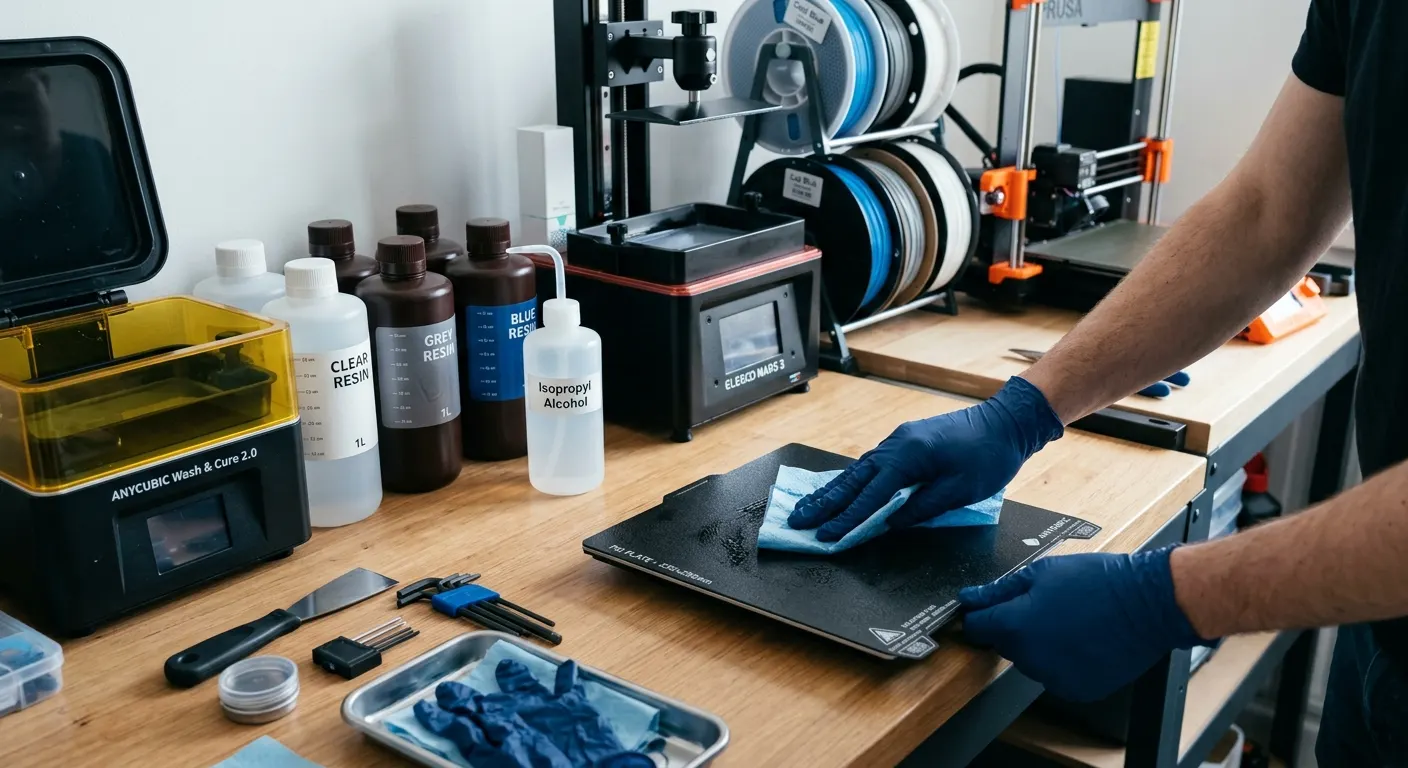
Build plate adhesion problems are usually chemistry, not calibration. Every time you press a fingertip onto a PEI sheet you deposit skin oil, and PLA will not bond to oil. The fix costs almost nothing: flood the cold plate with Amazon Basics Isopropyl Alcohol 99% , wipe with a clean paper towel in one direction, and let it flash off before the next print. The 99 percent concentration matters, lower drugstore concentrations leave water and additives behind on the plate.
When alcohol stops rescuing adhesion, the plate has built up a film IPA cannot cut, usually glue stick residue or baked-on polymer. That is the moment for warm water and unscented dish soap at the sink, dried with a lint-free cloth, not a reason to buy a new plate. A 3D Printer Tool Kit earns its place here too: the plastic scraper lifts stubborn skirts without gouging PEI, the flush cutters trim brims, and the needle files dress the small scars every well-used plate accumulates.
If you print PETG on smooth PEI, Magigoo 3D Printer Bed Adhesion Stick doubles as a release agent that protects the coating. It also washes off completely with warm water, which is exactly what you want from anything you put between plastic and plate: cleaning tools you cannot clean up after are not cleaning tools.
02
Nozzle care: when cleaning beats replacing, and when it does not
A partially clogged nozzle announces itself as inconsistent extrusion: thin perimeters, missing lines after retractions, a hiss where there should be a steady bead. The first response is a cold pull: heat to printing temperature, push filament through by hand, cool to roughly 90 degrees Celsius, and pull the filament out with the debris embedded in its tip. Two or three pulls clear most soft clogs without touching a tool. The needles in a 3D Printer Tool Kit handle the rest, cleared downward through a hot nozzle.
There is also a point where cleaning is false economy. Brass nozzles are consumables: a Creality MK8 Brass Nozzle Pack works out to roughly a dollar a nozzle, so once a clog resists two rounds of cold pulls, swapping is faster and gives you a known-good orifice instead of a maybe-clean one.
If you print abrasives, carbon fiber, glow, or wood fill, the cleaning conversation changes entirely, because the wear is inside the orifice where no needle reaches. A BIGTREETECH Hardened Steel Nozzle or the Bambu Lab Hardened Steel Nozzle Kit on Bambu machines stops the abrasion problem at the source, and clean hardened steel outlasts dozens of brass swaps.
03
The complete resin wash and cure workflow
Resin cleaning is not optional finishing, it is the second half of the print. A part off the plate is coated in uncured resin that will stay tacky indefinitely, block paint, and irritate skin on contact. The whole discipline is five moves, in order: drain the plate over the vat for a minute, wash four to six minutes in the station, rinse and inspect for glossy patches, dry until fully matte, then cure two to five minutes on the turntable. The equipment question is simpler than forums make it. A combined station like the ELEGOO Mercury Plus Wash and Cure Station runs both stages in one footprint: a stirred wash tank sized for the plate straight off the printer, then a rotating UV turntable for the cure. The Anycubic Wash and Cure Plus is the pick when you print on a larger-format machine and need the taller wash basket.
Wash liquid is a running cost you control. Standard resins want 90 percent plus isopropyl alcohol, reused across many washes: let the jug settle between sessions, decant the clear top, and sun-cure the sludge at the bottom into a disposable solid. ELEGOO Water Washable Resin trades a slightly softer surface for washing in plain water, which is worth it if ventilation or alcohol supply is a constraint, but the disposal rule does not relax: the wash water carries resin and gets cured before it goes anywhere.
Gloves are the non-negotiable line item. Nitrile Exam Gloves (100-Count Box) cost pennies a pair; resin sensitization is cumulative and permanent, and it does not announce itself until you have it. Box by the printer, gloves on before the lid opens, every session, including the quick ones. For ventilation and the rest of the safe-handling picture, our resin printing safety guide covers the room setup this workflow assumes.
04
Vat and FEP hygiene between prints
The vat is where resin printers quietly fail. Every failed print leaves a cured patch on the FEP film, and printing over debris is how films tear and screens die. After any failure, drain the vat through a paint filter back into the bottle, run a gloved finger across the film to find hardened fragments, and lift them out with the plastic scraper, never metal, from the tool kit.
FEP film is a consumable with a clear replacement signal: deep scratches, cloudiness that diffuses the image, or a slack drum-skin feel instead of a tight one. An ELEGOO FEP Film Replacement Sheet restores release performance for a few dollars, and it is worth re-tensioning carefully rather than quickly. When the vat frame itself warps or the coating wears, a full ELEGOO Resin Vat Replacement resets the whole consumable stack at once.
Between sessions, the vat either goes back in the printer under a dust cover with resin filtered clean, or gets emptied and wiped down with alcohol and soft paper towels. Both are fine; leaving a vat of debris-laden resin open to dust for a week is the option that costs you a screen.
05
What a complete cleaning kit costs
The full FDM side of this guide, alcohol, tool kit, adhesion stick, and a pack of spare brass nozzles, lands well under 60 dollars and covers years of maintenance. The resin side is one station, one glove box, and consumable film, roughly 120 to 150 dollars all-in. Set against a single replaced build plate, LCD screen, or abandoned printer, the cleaning kit is the highest-return purchase in the hobby.
Buy the alcohol and the tool kit with the printer, add the wash and cure station the same day you buy your first resin bottle, and treat gloves and FEP film like filament: consumables you reorder before you run out, not after.
What should I clean a PEI build plate with, and how often?+
Wipe with 99 percent isopropyl alcohol before every print session, and wash with warm water and unscented dish soap once alcohol stops restoring adhesion. Soap removes the oil and glue film IPA cannot cut. Avoid acetone on smooth PEI; it degrades the coating.
Do I really need a wash and cure station, or can I use two tubs?+
Two lidded tubs of alcohol and a sunny windowsill do work, and many people start that way. A station adds agitation, a timer, and a rotating UV turntable, so parts come out cleaner and cure evenly in minutes instead of hours. At hobbyist prices it is usually the second resin purchase that makes sense.
How often should FEP film be replaced?+
Replace on condition, not a schedule: deep scratches, cloudiness, or lost tension mean it is due. A film can last months of clean printing or die in a week of failures. Keeping the vat free of cured debris is what actually extends its life.
Can water-washable resin rinse water go down the drain?+
No. The wash water contains suspended uncured resin, which is aquatic-toxic. Leave it in a clear container in sunlight until the resin cures and settles, filter or decant, and dispose of the cured solids in the trash. The same rule applies to spent isopropyl alcohol.