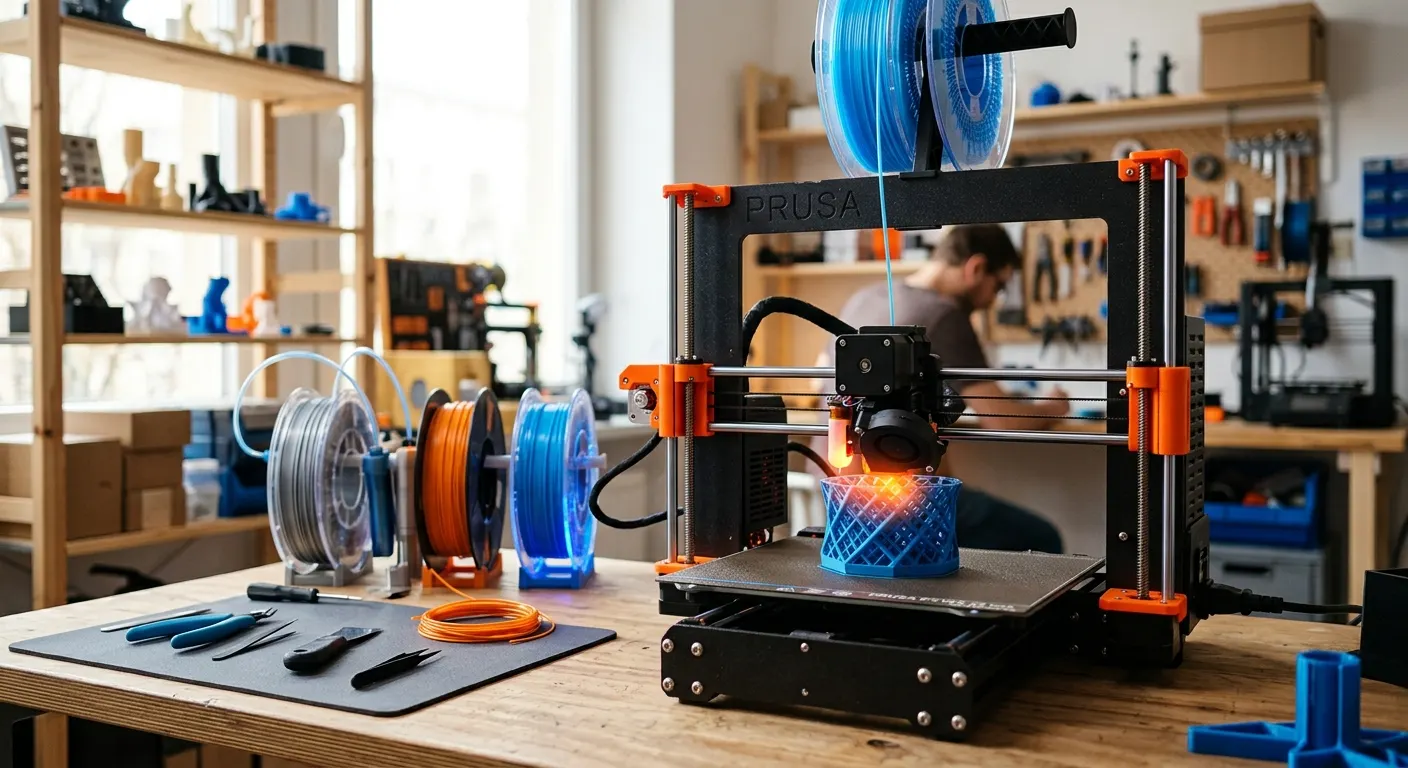
Numbers move faster than opinions in 3D printing, and the consumer and desktop end of the market is where the steepest curves are right now. This page collects 44 verified statistics for 2026 on market size, growth rates, printer shipments, vendor share, and the maker community, drawn from MarketsandMarkets, Grand View Research, Precedence Research, Wohlers, Protolabs, CONTEXT, and others. Every figure below names its source and year in plain text so you can cite it, check it, or build on it.
Quick answer
The global 3D printing market is worth USD 16.16 billion in 2025 and is projected to reach USD 35.79 billion by 2030, a 17.2 percent compound annual growth rate, according to MarketsandMarkets. The desktop segment is growing even faster at a 23.8 percent annual rate through 2030 per Grand View Research.
This guide contains affiliate links. LayerGrade may earn a commission at no cost to you.
Market size: how big is 3D printing in 2026
According to MarketsandMarkets, the global 3D printing market is valued at USD 16.16 billion in 2025. Grand View Research, via PR Newswire, projects the same broad market reaching USD 76.17 billion by 2030, a higher figure that reflects a wider definition of the industry than the MarketsandMarkets estimate.
The desktop slice that matters most to hobbyists and small studios is sizable on its own. Grand View Research valued the desktop 3D printing market at USD 5.88 billion in 2024. The materials side is smaller but steady: Precedence Research put the 3D printing filament market at USD 1.27 billion in 2025.
Independent industry trackers report similar scale through different lenses. The Wohlers Report 2024 from Wohlers Associates and ASTM measured total additive manufacturing industry revenue at USD 20.035 billion for 2023, and the Wohlers Report 2025 raised that to USD 21.9 billion for 2024. The Protolabs and Hubs 3D Printing Trend Report 2024, cited by 3D Printing Industry, estimated the market reached USD 24.8 billion by the end of 2024.
On the vendor side, the Creality IPO prospectus, reported by 3D Printing Industry, disclosed total 2024 revenue of RMB 2.288 billion, roughly USD 326.8 million, a useful anchor for how much money flows through a single leading desktop brand.
Growth: how fast 3D printing is expanding
The headline growth rate depends on whose definition you use, but every major forecaster agrees the direction is steeply up. MarketsandMarkets projects the overall 3D printing market growing from USD 16.16 billion in 2025 to USD 35.79 billion by 2030, a compound annual growth rate of 17.2 percent. Grand View Research, via PR Newswire, models a faster 20.8 percent rate from 2022 toward USD 76.17 billion by 2030.
The desktop segment outpaces the broader market. Grand View Research forecasts a 23.8 percent compound annual growth rate for desktop 3D printing from 2025 to 2030, lifting it to USD 20.93 billion by the end of the decade. The filament market grows more modestly, at a 12.81 percent annual rate from 2026 toward USD 4.24 billion by 2035, according to Precedence Research.
Looking further out on the demand side, the Protolabs and Hubs 3D Printing Trend Report 2024, cited by 3D Printing Industry, projects the market reaching USD 57.1 billion by 2028. The Wohlers Report 2024 recorded industry revenue growth of 11.1 percent for 2023, and the Wohlers Report 2025 noted growth had cooled to 9.1 percent for 2024, a sign the post-pandemic surge is normalizing even as the absolute figures keep climbing.
On the education front, the Y Soft and Dimensional Research survey reported by 3DPrint.com found that 77 percent of educators planned to increase their 3D printer purchases, evidence that demand growth is not confined to industry alone.
Equipment: printers, vendors, and where the hardware comes from
The entry-level segment has become the center of gravity for hardware. CONTEXT data reported by 3D Printing Industry showed four Chinese vendors, Creality, Bambu Lab, Anycubic, and Elegoo, accounting for 94 percent of all sub-USD 2,500 printer shipments in the second quarter of 2024. In that same quarter, industrial 3D printer shipments fell 25 percent year over year, a sharp contrast with the consumer boom.
Vendor leadership at the entry level is concentrated. According to the Creality IPO prospectus, reported by 3D Printing Industry, Bambu Lab shipped about 1.2 million printers in 2024, roughly 29 percent of annual shipments, while Creality shipped approximately 700,000 units, about 16.9 percent. CONTEXT data, via 3D Printing Industry, put Creality at a 39 percent entry-level market share in the first quarter of 2025, with Bambu Lab entry-level shipments up 64 percent year over year.
The industrial metal side tells a different story. The Wohlers Report 2024 from Wohlers Associates and ASTM recorded 3,793 metal additive manufacturing systems sold in 2023, a 24.4 percent increase in metal system shipments for the year.
Most of the world's desktop hardware ships from China. China trade export data compiled by Kingroon shows that of 1.829 million 3D printers exported in the first half of 2024, 99.5 percent, or 1.82 million units, were desktop machines, underscoring how thoroughly the consumer category drives global volume.
Participation: shipments, makers, and community activity
Unit volume at the low end is enormous and still rising. CONTEXT data reported by 3D Printing Industry recorded a quarterly record of 993,000 entry-level printers shipped in the fourth quarter of 2023, up 35 percent year over year, then more than 1 million units in the first quarter of 2025, up another 15 percent. Cumulatively, the Creality IPO prospectus, via 3D Printing Industry, reported 4.4 million Creality printers shipped from 2020 to 2024.
Among businesses, usage is intensifying. The Protolabs and Hubs 3D Printing Trend Report 2024, cited by 3D Printing Industry, found that 70 percent of respondents printed more parts in 2023 than in 2022, and 67 percent used 3D printing primarily for prototyping.
The maker community is where consumer momentum is most visible. Wikipedia reports that Thingiverse now hosts more than 1 million open-source hardware designs. Bambu Lab, via 3DPrint.com, says its MakerWorld platform reached 10 million monthly active users in 2025, hosts 2.6 million original models with about 7,000 added daily, and has logged 290 million total print hours.
If you are part of that community and printing display models, a flagship matte filament like Polymaker PolyTerra PLA is the kind of everyday spool that turns those download counts into finished prints. Education remains a quieter but real driver too: the Y Soft and Dimensional Research survey reported by 3DPrint.com found 87 percent of schools limit student access to 3D printing, a participation ceiling the sector is still working to raise.
Demographics: who is printing and where
The 3D printing user base skews male but is slowly broadening. The Sculpteo State of 3D Printing 2019 report, via VoxelMatters, recorded women at 13 percent of survey respondents, described at the time as the highest yet. A more recent Airwolf 3D printing survey in 2024 put the gender split at 62.2 percent male and 37.8 percent female, with an average respondent age of 43.8 years.
Use cases in that 2024 Airwolf survey divided almost evenly, at 51.3 percent manufacturing and 48.7 percent education, a reminder that the consumer and professional audiences overlap heavily at the desktop level.
Geographically, the United States is the single largest destination for Chinese-made desktop machines. China trade export data compiled by Kingroon shows 680,000 of those printers, about 37.2 percent of first-half 2024 exports, were shipped to the US, making American makers a dominant share of the global desktop install base.
Economics: revenue, value, and the cost question
The money behind the hardware is concentrating around a handful of brands. The Creality IPO prospectus, reported by 3D Printing Industry, disclosed RMB 2.288 billion in 2024 revenue, roughly USD 326.8 million, for a single desktop manufacturer. At the industry level, the Wohlers Report 2025 from Wohlers Associates and ASTM measured total additive manufacturing revenue of USD 21.9 billion for 2024.
The consumer tier now commands a striking share of that revenue. CONTEXT data reported by 3D Printing Industry found that entry-level printers made up 48 percent of global 3D printer revenue in the second quarter of 2024, versus 38 percent for industrial machines, and entry-level shipment growth ran 65 percent year over year in that quarter.
Return on investment remains the open question in some settings. The Y Soft and Dimensional Research education survey reported by 3DPrint.com found that 90 percent of respondents could not justify the ROI on their 3D printing investment, a candid counterweight to the enthusiasm in the shipment and market-size figures above.
Sources
MarketsandMarkets, 3D Printing Market report, 2025 to 2030 (market size USD 16.16 billion in 2025, USD 35.79 billion by 2030, 17.2 percent CAGR).
Grand View Research via PR Newswire, 3D Printing Market Size Worth USD 76.17 Billion by 2030, 2022 (USD 76.17 billion by 2030, 20.8 percent CAGR).
Grand View Research, Desktop 3D Printing Market Report, 2024 to 2030 (USD 5.88 billion in 2024, USD 20.93 billion by 2030, 23.8 percent CAGR).
Precedence Research, 3D Printing Filament Market, 2025 to 2035 (USD 1.27 billion in 2025, USD 4.24 billion by 2035, 12.81 percent CAGR).
Wohlers Report 2024, Wohlers Associates and ASTM, 2023 data (USD 20.035 billion industry revenue, 11.1 percent growth, 3,793 metal systems sold, 24.4 percent metal system growth).
Wohlers Report 2025, Wohlers Associates and ASTM, 2024 data (USD 21.9 billion industry revenue, 9.1 percent growth).
Protolabs and Hubs 3D Printing Trend Report 2024 via 3D Printing Industry, 2024 (USD 24.8 billion market, USD 57.1 billion by 2028, 70 percent printing more parts, 67 percent prototyping, 76 percent printing 10 or more parts per run).
CONTEXT via 3D Printing Industry, 2024 and 2025 data (entry-level 48 percent of revenue, 65 percent shipment growth, 94 percent Chinese-vendor share, industrial down 25 percent, over 1 million entry-level units in Q1 2025, 993,000 units in Q4 2023, Bambu Lab up 64 percent, Creality 39 percent share).
Creality IPO prospectus via 3D Printing Industry, 2024 (Bambu Lab 1.2 million units and 29 percent share, Creality 700,000 units and 16.9 percent share, 4.4 million cumulative Creality units, RMB 2.288 billion revenue).
China trade export data via Kingroon, first half 2024 (1.829 million printers exported up 40.3 percent, 99.5 percent desktop, 680,000 to the US at 37.2 percent).
Wikipedia, Thingiverse, 2024 (more than 1 million open-source hardware designs).
Bambu Lab via 3DPrint.com, 2025 (MakerWorld 10 million monthly active users, 2.6 million models with 7,000 added daily, 290 million print hours).
Y Soft and Dimensional Research education survey via 3DPrint.com, 2016 (87 percent of schools limit access, 77 percent of educators increasing purchases, 90 percent unable to justify ROI).
Sculpteo State of 3D Printing 2019 via VoxelMatters, 2019 (13 percent women respondents).
Airwolf 3D printing survey, 2024 (62.2 percent male and 37.8 percent female, average age 43.8 years, 51.3 percent manufacturing and 48.7 percent education).
FAQ
Frequently asked questions
How big is the 3D printing market in 2026?+
According to MarketsandMarkets, the global 3D printing market is valued at USD 16.16 billion in 2025, the most recent annual figure heading into 2026. Grand View Research, via PR Newswire, uses a broader definition and projects the market reaching USD 76.17 billion by 2030, while the Protolabs and Hubs Trend Report 2024 estimated the market hit USD 24.8 billion by the end of 2024.
Is 3D printing still growing?+
Yes. MarketsandMarkets projects a 17.2 percent compound annual growth rate from 2025 to 2030, and Grand View Research forecasts the desktop segment growing even faster at 23.8 percent per year through 2030. The Wohlers Report 2025 did note growth cooled to 9.1 percent in 2024 from 11.1 percent in 2023, so the rate is moderating even as the totals keep rising.
How many desktop 3D printers are shipped each year?+
CONTEXT data reported by 3D Printing Industry recorded more than 1 million entry-level printers shipped in the first quarter of 2025 alone, up 15 percent year over year, after a record 993,000 units in the fourth quarter of 2023. Cumulatively, the Creality IPO prospectus reported 4.4 million Creality printers shipped from 2020 to 2024.
What percentage of 3D printers come from China?+
China trade export data compiled by Kingroon shows 1.829 million 3D printers were exported from China in the first half of 2024, up 40.3 percent year over year, and 99.5 percent of those were desktop machines. CONTEXT also found four Chinese vendors, Creality, Bambu Lab, Anycubic, and Elegoo, accounted for 94 percent of sub-USD 2,500 printer shipments in the second quarter of 2024.
Who are the biggest desktop 3D printer brands?+
According to the Creality IPO prospectus reported by 3D Printing Industry, Bambu Lab shipped about 1.2 million printers in 2024, roughly 29 percent of annual shipments, and Creality shipped approximately 700,000 units, about 16.9 percent. CONTEXT data placed Creality at a 39 percent entry-level market share in the first quarter of 2025, with Bambu Lab shipments up 64 percent year over year.
How big is the maker community for 3D printing?+
Wikipedia reports Thingiverse hosts more than 1 million open-source hardware designs. Bambu Lab, via 3DPrint.com, says its MakerWorld platform reached 10 million monthly active users in 2025, hosts 2.6 million original models with about 7,000 added daily, and has logged 290 million total print hours.